Structured Collaboration
Make it easy for capable people to get things done together
Our work is built on Structured Collaboration, a modern way to manage and optimise the performance of modern organisations and a modern workforce. It distils what 25 years and more than 70 client organisations have shown us works in complex knowledge-work organisations.
The problem
Management built for a simpler era now slows organisations down
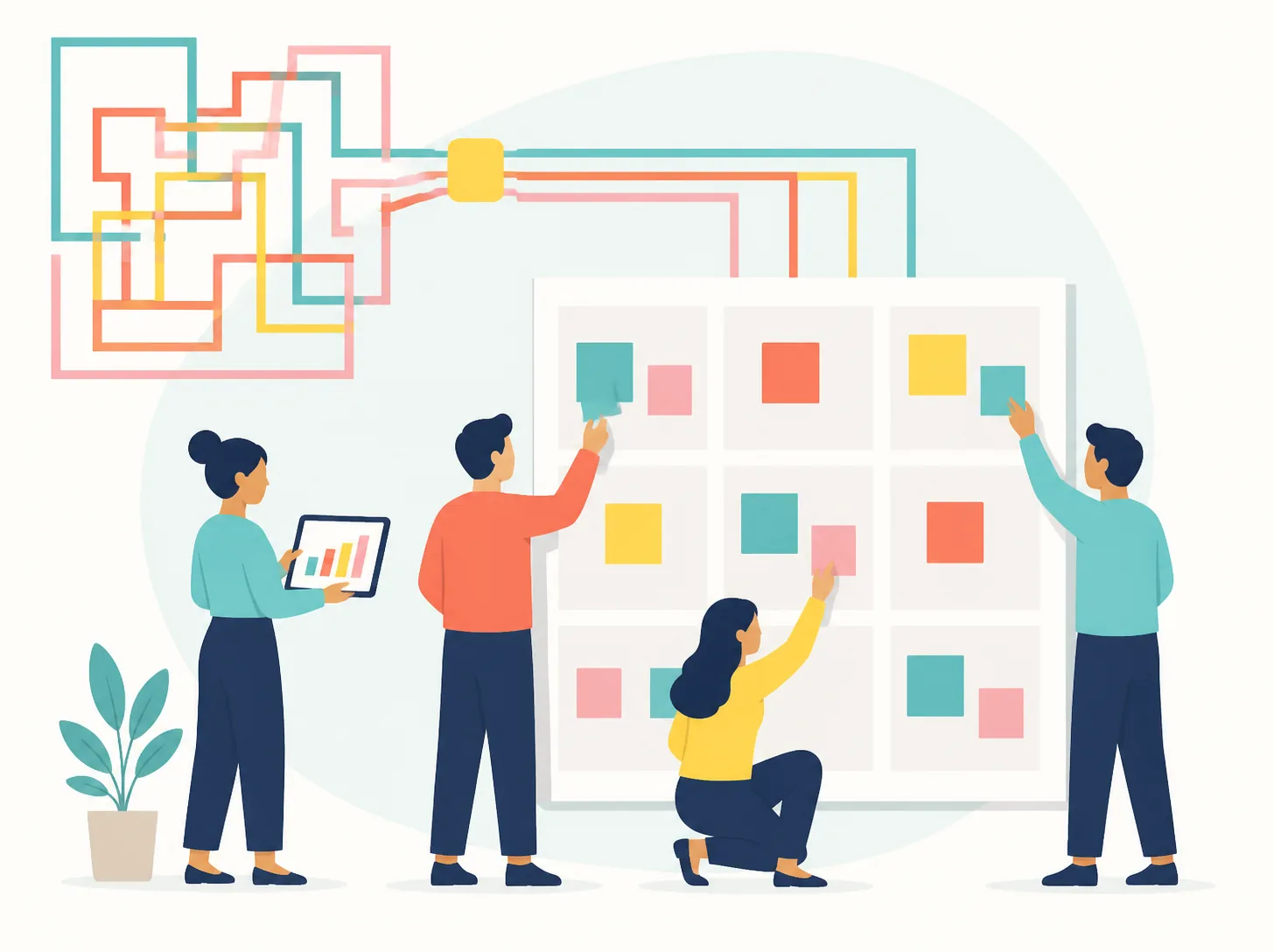
Most management methods were built to tell people what to do and check that they did it. Today’s organisations run on the knowledge of people spread across teams, functions and offices. Decisions queue at the top, work stalls between teams, managers chase instead of leading, and results depend on a few heroes.
Service and knowledge-work organisations face an extra gap: they never built the discipline of operations management that manufacturing spent a century developing.
Our approach
A blueprint for building and managing a high-performing organisation
Methods such as the Business Model Canvas help an organisation decide what it should do. Structured Collaboration provides the how.
It manages through intent rather than instruction, and it updates traditional management rather than throwing it away. Leaders make clear what needs to be achieved and why. People are trusted to decide how. A light structure keeps everyone moving the same way: agreed handoffs between teams, clear decision rights, and a regular rhythm for reviewing progress together.
How it works
Structures that help people work as one
The tools are the structures. Each one brings the evidence on how the business is really performing into the open, so the people who do the work can find the best answers together. We believe that with better-quality information, people make better-quality decisions.
- 1 · Senior teams
Concurrent Management
The people responsible for connected parts of the business make connected decisions together, in one forum rather than several separate committees.
- 2 · Across teams and functions
Designed interfaces
Teams agree what flows between them, to what standard, and how problems are resolved. Every end-to-end process has an owner.
- 3 · The whole business
A shared picture
Everyone shares one view of how the organisation creates value and how its parts fit, and strategy is carried down to each team’s priorities.
Direction flows down to the teams, and the issues they can’t resolve on their own flow back up, so the organisation keeps learning and improving. See the three levels
How it fits with other methods
Built on a number of management best practices, brought together in one integrated framework
Structured Collaboration draws on service quality, Lean and operational excellence, strategy deployment, process management, systems thinking, team and operations management, collaboration research and complexity science. It applies them where they have been hardest to apply: the work that crosses teams, functions and offices.
What changes
An organisation that runs reliably and keeps getting better
- People get things done without fighting the system.
- Managers lead rather than chase.
- Decisions are made closer to the work, and faster.
- Performance is predictable and reliable, not dependent on heroes.
- Your own people keep improving how the work runs, so the results last.
The tools
Free to try, on a worked example
Every tool can be tried free on a worked example, Harbourline Services. One free account keeps your own work in all of them.
Build it right first time
- Customer Value Canvas
- Business Execution Canvas® Builder
- Strategy Deployment Canvas
- Structured Collaboration Canvas™
Run the business
- CollabForce365: plan each team’s work against real capacity (formerly ServiceForce)
- Process Management, for process owners and managers
- Forum Decision Canvas
Improve it
- Business Execution Canvas® Diagnostic
- Priority Decision Matrix
- A3 Problem Solving
- Kata Storyboard
Courses
Structured Collaboration Foundations is a free online course: six modules, about 4¼ hours. Practitioner and senior-team courses are coming soon. See the courses
Where Expertivity comes in
The tools and courses help you see the problem and learn the method. Where you want hands-on help to make the changes and make them stick, the Expertivity team works alongside your people.